

The Southern Resident orcas face a critical moment. Only 75 whales remain as of December 2025. These iconic killer whales return to the San Juan Islands each summer to feed on Chinook salmon. The 2026 season offers another chance to see them in their natural habitat.
This guide covers the latest population numbers from the Center for Whale Research, best viewing months, and how you can experience these whales responsibly. We also explain why kayaking provides a quieter, closer encounter than motorized boats.


Beyond marine mammals, kayakers frequently spot bald eagles (the San Juan Islands have one of the highest nesting densities in the lower 48 states), great blue herons, black oystercatchers, rhinoceros auklets, and river otters along the shoreline.
All tours include professional guides, quality equipment, and safety instruction. No experience required. Whale sightings are never guaranteed — Southern Resident orcas are wild, endangered animals.
75Orcas Remaining
3 PodsJ, K & L Pods
May–SepPeak Season
90%Sighting Rate (Summer)
From $129Kayak Tour Price
35+ YearsSea Quest Experience
🐋 2026 Season Now Booking
Whale Watching Kayak Tours — San Juan Islands
See orcas at eye level from a silent kayak. Professional guides, all equipment provided, no experience needed. Tours from $129. Book a Tour ☎ 360-378-57672025–2026 Southern Resident Orca Census Results
The Center for Whale Research released the 50th annual orca census in October 2025. The count stood at 74 whales as of July 1, 2025. By December 2025, a new calf brought the total to 75. Current Population by Pod:
⚠ K-Pod at Risk: K-pod has reached its lowest number since records began in 1976 — only 15 members. No viable calf had survived in K-pod since 2022 until the arrival of K47 in December 2025. Researchers say K-pod faces the highest extinction risk among the three pods.
New Calves Born in 2025
Four calves were born during the 2024–2025 census period. Three survived:- J63 — Female, born to J40 in April 2025. This is J40’s first calf.
- J64 — Born to J42 in September 2025. J42 is a first-time mother.
- K47 — First spotted in December 2025. This calf gives K-pod hope for recovery.
Why the San Juan Islands Are the Best Place to See Orcas
The San Juan Islands sit in the middle of the Salish Sea. This location makes them the primary summer home for Southern Resident orcas. Over 95% of all orca sightings in Washington state occur along the western edge of the San Juan Islands. Three factors make this area ideal for whale watching.Summer Feeding Grounds
From May through September, Chinook salmon return to rivers in Washington and British Columbia. The orcas follow these fish through Haro Strait along San Juan Island’s west side.Chinook Salmon Runs
A single adult orca can eat 200–300 pounds of fish per day. When salmon runs are strong, orcas spend more time near the islands. Weak salmon years push them to search farther.Lime Kiln Point State Park
The only park in the world dedicated to land-based orca watching. Located on San Juan Island’s west side with underwater hydrophones that stream orca calls live.Best Months to See Orcas in 2026
Orcas can appear near San Juan Island any month. However, your chances improve dramatically during the summer season.| Season | Months | What to Expect |
|---|---|---|
| Peak Season | June – August | 90% sighting rate, best weather, Southern Residents most active |
| Shoulder Season | April – May, Sept – Oct | Good sightings, fewer crowds, Bigg’s orcas common |
| Off Season | November – March | Bigg’s orcas year-round, humpback whales possible, weather variable |
Peak Season: June Through August
The peak whale watching season runs from mid-May through mid-September. During these months, tour operators report a 90% success rate for whale sightings. June, July, and August offer the highest probability. Salmon runs reach their peak, and orcas spend extended time feeding in local waters. For more detailed whale watching information, visit our dedicated guide.J-Pod: The Most Reliable Sightings
J-pod is the most frequently seen group. This pod spends more time in inland waters than K-pod or L-pod. J-pod also shows the healthiest growth rate. With recent births and no adult deaths, J-pod currently has 27 members. When visiting the San Juan Islands, you are most likely to encounter J-pod whales.Bigg’s (Transient) Orcas: Year-Round Sightings
Bigg’s killer whales, also called transients, hunt marine mammals instead of fish. They eat seals, sea lions, and porpoises. Unlike the salmon-dependent Southern Residents, Bigg’s orcas visit the San Juan Islands throughout the year. Their population has grown to over 400 whales in the region. Tour operators often spot Bigg’s orcas during shoulder months when Southern Residents are less present.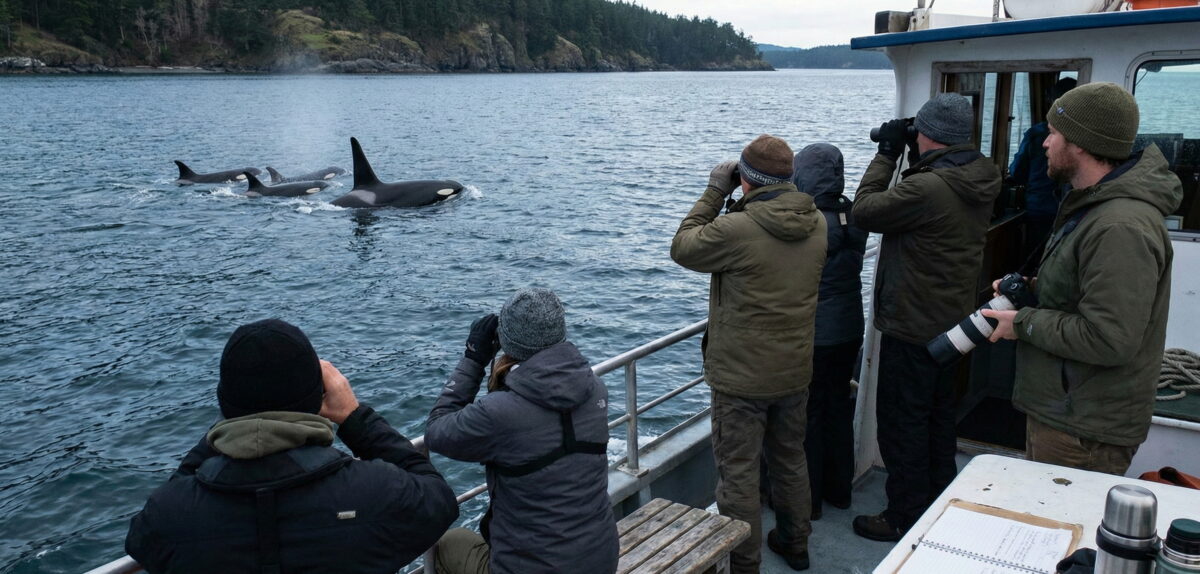
Whale & Wildlife Species You May See
The San Juan Islands support a remarkable diversity of marine wildlife. Here are the whale and marine mammal species you may encounter on a kayak tour, organized by season:| Species | Best Months | Diet | Frequency |
|---|---|---|---|
| Southern Resident Orcas (J, K, L pods) | June – August | Chinook salmon | Seasonal — follows salmon runs |
| Bigg’s (Transient) Orcas | Year-round | Seals, sea lions, porpoises | Increasing — 400+ in region |
| Humpback Whales | August – October | Herring, krill | Growing — returning to Salish Sea |
| Gray Whales | March – May | Bottom-dwelling invertebrates | Annual northward migration |
| Minke Whales | May – September | Small fish, krill | Common in summer |
| Harbor Porpoises | Year-round | Small fish, squid | Very common — daily sightings |
| Dall’s Porpoises | Year-round (peak Sept) | Small fish, squid | Common |
| Harbor Seals | Year-round | Fish, squid | Abundant — 5,000+ in the islands |
Whale Watching by Kayak: A Quieter Way to See Orcas
Kayaking provides a whale watching experience that motorized boats cannot match. Three key advantages make kayaking the preferred choice for many visitors.Quiet Observation
Kayaks produce no motor noise. Research shows vessel noise disrupts orca echolocation and feeding. You float silently while whales pass nearby.Eye-Level Encounters
A kayak sits low in the water. You hear the blow of an orca’s breath and see spray from their dorsal fin. The scale of these animals becomes real at sea level.35+ Years of Expertise
Sea Quest Kayak Tours has guided whale watching kayak tours since 1989 — selected by National Geographic for their “10 Best Trips in the World” and featured on ABC News. Our biologist and naturalist guides know tides, currents, and seasonal orca patterns.Kayak vs. Motorized Boat: Which Is Better for Whale Watching?
| Factor | Kayak Tour | Motorized Boat Tour |
|---|---|---|
| Noise Level | Silent — no engine noise | Engine noise can disturb orca echolocation |
| Perspective | Eye-level on the water | Elevated deck view |
| Environmental Impact | Zero emissions, minimal wake | Fuel emissions, wake disturbance |
| Duration | 3–6 hours (day), 2–5 days (expedition) | 3–5 hours typical |
| Price Range | $129–$1,199 | $100–$150 typical |
| Experience Required | None — instruction provided | None |
| Group Size | Small (6–12 paddlers) | Larger (20–50+ passengers) |
| Additional Wildlife | Intertidal zones, kelp forests, tidepools | Open-water sightings primarily |
✓ No Experience Needed: All tours include instruction for beginners. Sea Quest provides stable tandem kayaks, safety gear, and detailed briefings before each trip. Read what our guests say about their experience.
How You Can Help Protect the Southern Residents
The Southern Resident orcas remain endangered. Their population has hovered between 73–75 whales for several years. Recovery requires action on multiple fronts.The Quiet Sound Initiative
Quiet Sound encourages commercial vessels to slow down in orca habitat. Slower ships produce less noise. The program runs from October through January. Voluntary slowdowns have shown measurable reductions in underwater noise levels. Support this initiative by choosing tour operators who follow noise reduction guidelines.Updated Viewing Distance Rules (Effective January 2025)
Federal and Washington state law protect orcas from harassment. As of January 1, 2025, Washington state law (RCW 77.15.740) requires all vessels — including kayaks, paddleboards, motorized boats, and ferries — to maintain at least 1,000 yards (approximately 0.6 miles) from Southern Resident killer whales. This is a significant increase from the previous 300-yard minimum. For Bigg’s (transient) orcas and other marine mammals, the standard Be Whale Wise guidelines apply:- Stay at least 300 yards from Bigg’s orcas and other whales
- Stay at least 1,000 yards from all Southern Resident orcas (Washington state law)
- Turn off engines and reduce speed when any whales are present
- Do not position your vessel in front of traveling whales
- Leave the area if whales show signs of disturbance
⚠ Important: The 1,000-yard rule applies to ALL watercraft without exception. Violators face fines. Sea Quest guides strictly comply with all current regulations and maintain safe distances at all times. We never chase or approach whales directly. If whales approach us, we remain stationary and allow them to pass.
Chinook Salmon Recovery
Food scarcity is the primary threat to Southern Resident survival. Nearly 75% of orca pregnancies fail before birth, largely due to nutritional stress. Restoring Chinook salmon populations requires:- Protecting river spawning habitat from development
- Removing outdated dams that block fish passage
- Reducing fishing pressure on struggling salmon stocks
- Cleaning pollutants from rivers and streams
How to Get to San Juan Island
San Juan Island is easily accessible from Seattle and the greater Puget Sound area:- By car + ferry: Drive approximately 90 minutes north from Seattle via I-5 to Anacortes. Take the Washington State Ferry from Anacortes to Friday Harbor (approximately 75 minutes). Reservations recommended in summer.
- By seaplane: Kenmore Air offers direct flights from Seattle (Lake Union) and Renton to Friday Harbor — about 45 minutes.
- By shuttle + ferry: The Airporter Shuttle runs from Sea-Tac Airport to the Anacortes ferry terminal.
Book Your 2026 Whale Watching Kayak Tour
The 2026 orca season begins in April. Peak months fill up fast. Book your kayak tour now to secure your preferred dates.🐋 Since 1989 — Friday Harbor, WA
Reserve Your 2026 Orca Kayak Tour
Peak season fills fast. Book now to secure your preferred dates. All skill levels welcome. Book a Tour ☎ 360-378-5767Frequently Asked Questions
The best time is June through August, when Southern Resident orcas follow Chinook salmon runs through the Salish Sea. Tour operators report a 90% sighting rate during these peak months. Shoulder months (April–May, September–October) also offer good chances with fewer crowds. Bigg’s (transient) orcas can be seen year-round.
No experience is needed. Sea Quest provides stable tandem kayaks, full safety gear, and instruction before every trip. All skill levels are welcome, including complete beginners. Guides paddle with you the entire time and handle all the logistics.
As of December 2025, there are 75 Southern Resident orcas across three pods: J-pod (27 members), K-pod (15 members), and L-pod (33 members). The population has hovered between 73–75 whales for several years. They remain federally endangered under the Endangered Species Act.
As of January 1, 2025, Washington state law (RCW 77.15.740) requires all vessels — including kayaks — to stay at least 1,000 yards from Southern Resident orcas. For Bigg’s (transient) orcas, the standard Be Whale Wise distance of 300 yards applies. Sea Quest guides strictly follow all current regulations. If whales approach you, remain stationary and let them pass.
Southern Resident orcas eat fish (primarily Chinook salmon) and visit the San Juan Islands mainly from May through September. Bigg’s (transient) orcas eat marine mammals like seals and sea lions and can be seen year-round. The Bigg’s population is thriving with over 400 whales in the region, while the Southern Residents are critically endangered at 75 individuals. Both types are frequently spotted in the Salish Sea.
Half-day tours start at $129 (3 hours). Full-day tours are $179 (6 hours, lunch included). Bioluminescence night tours are $199. Multi-day camping expeditions range from $649 to $1,199. All tours include professional guides, quality equipment, and safety instruction.
Sea Quest Kayak Tours operates from Friday Harbor on San Juan Island, Washington. The address is 322 Daniel Ln, Unit 6, Friday Harbor, WA 98250. You can reach the island by Washington State Ferry from Anacortes (about 75 minutes) or by seaplane from Seattle with Kenmore Air (about 45 minutes).
No — whale sightings are never guaranteed. Orcas are wild animals and can change course unpredictably. However, Sea Quest has over 35 years of experience locating whales and our guides are biologists who know orca behavior, tides, and seasonal patterns. During peak months (June–August), tour operators report a 90% success rate for whale sightings of any species. Even without orcas, tours feature seals, eagles, porpoises, and stunning island scenery.
Population counts move one birth at a time, and each one matters for the Southern Residents. From our archives: a January calf born to J Pod — the first baby orca of its year, delivered by a mother just 12 years old.