

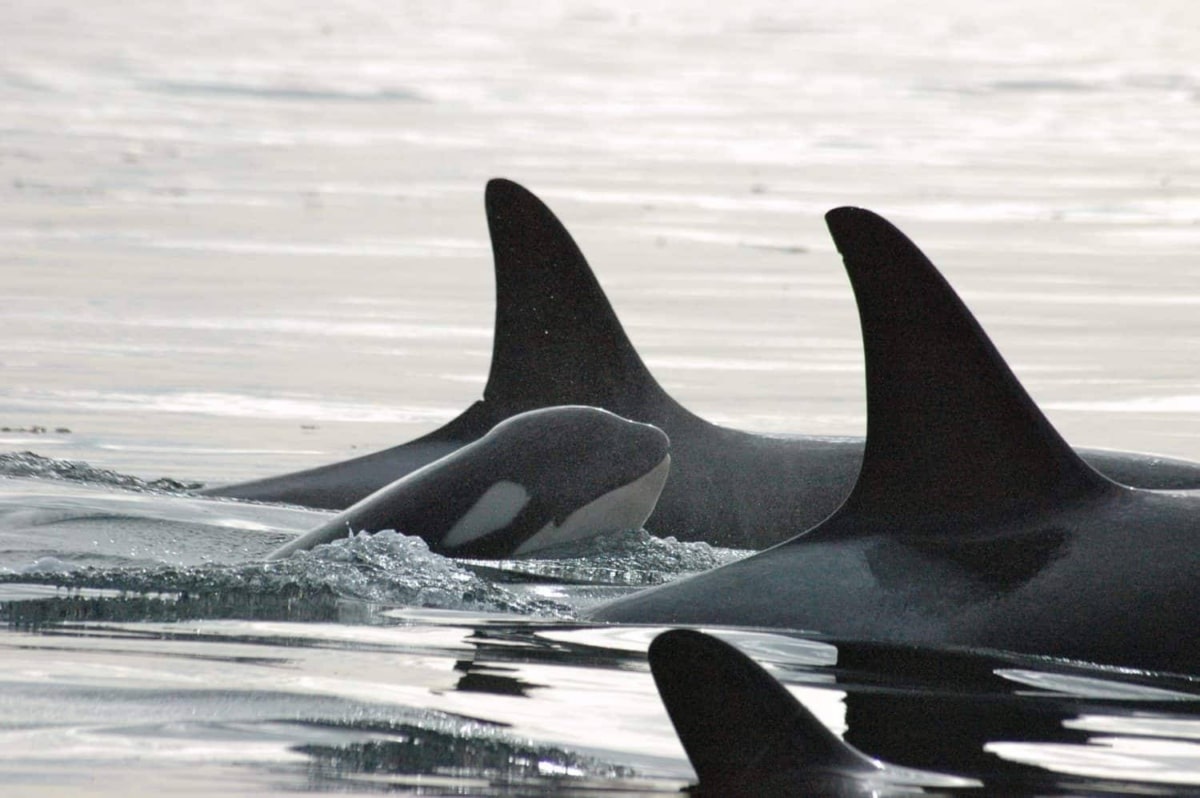
Whale watching kayak tours bring you to sea level with orcas, minke whales, harbor porpoises, and sometimes humpbacks. You sit one to three feet above the water. Sound carries differently. A blow from a passing whale can stop conversation in a way no boat deck can match.
This guide covers what to expect on a paddle, how kayak tours differ from boat tours, the best months to book, and how Sea Quest runs whale watching kayak tours in the Salish Sea, Alaska, and Baja Mexico.
Table of Contents
- How Whale Watching Kayak Tours Work
- What Whales You Can See
- Best Season for Each Whale Species
- Kayak vs Boat Tours
- What to Bring
- Staying Safe and Legal
- Frequently Asked Questions
How Whale Watching Kayak Tours Work
A guided whale watching kayak tour follows a simple rhythm. Your guide checks the daily marine forecast, picks a launch site that matches the wind and tide, and briefs the group on safety, paddle strokes, and wildlife viewing rules.
Most groups paddle two-person tandem kayaks, which are stable and easy to learn. Tours range from three-hour half-day trips to five-day expeditions with kayak camping at the side.
- Half-day tours: 3 to 4 hours on the water, 1 to 2 launch sites.
- Full-day tours: 6 to 7 hours, lunch on a small island.
- Multi-day expeditions: 2 to 5 nights, campsites on protected islands.
What Whales You Can See
The species depends on the location and the month.
- Orcas (killer whales). Two populations move through the San Juan Islands: Southern Resident orcas (salmon eaters, threatened) and Bigg’s orcas (mammal eaters, more often seen now).
- Humpback whales. Numbers in the Salish Sea have grown since 2010. Sightings are most common from May through October.
- Minke whales. Small, fast, often solitary. Watch for them at Salmon Bank.
- Gray whales. Pass the islands during their March-May northbound migration. Up close encounters happen during our gray whale tour in Baja.
- Blue whales. The largest animal on Earth. Found on our blue whale Baja kayak trips in winter.

Best Season for Each Whale Species
Pick your tour around the species you want to see.
| Species | Best Region | Peak Months |
|---|---|---|
| Bigg’s orca | San Juan Islands | May – October |
| Southern Resident orca | San Juan Islands | July – September |
| Humpback | San Juan Islands, SE Alaska | June – October |
| Minke | San Juan Islands | May – September |
| Gray whale | Baja Mexico | February – April |
| Blue whale | Baja Mexico | January – March |
Kayak vs Boat Tours
Both tour types have a place. The right pick depends on how active you want to be and how close you want the experience to feel.
- Kayak tours are quieter. Kayaks float at the legal viewing distance and let you hear blows, splashes, and bird calls.
- Boat tours cover more ground in a day. They are useful for travelers with limited mobility or short visits.
- Combined trips work well: a half-day boat tour to scout pod locations, then a kayak tour the next day in calmer water.
Read our deeper comparison in the kayak whale watching San Juan Islands guide.
What to Bring
Sea Quest provides the kayak, paddle, life vest, spray skirt, and dry bag. You bring clothing for the conditions and a few personal items.
- Synthetic or wool layers. Skip cotton.
- A waterproof rain jacket and pants.
- Closed-toe water shoes or old sneakers.
- Sunscreen, sunglasses with a strap, and a brimmed hat.
- A 1-liter water bottle and a snack.
- Small dry bag for a phone or camera (we provide larger dry bags).
Staying Safe and Legal
Federal law in U.S. waters sets a minimum approach distance for whales. Kayakers must keep at least 300 yards on the side and 400 yards in front or behind Southern Resident orcas. Boats must keep similar distances and stay outside vessel exclusion zones. The NOAA Fisheries vessel rules explain the current limits.
Your guide tracks each pod’s direction. If a whale changes course toward your group, the rule is to stop, raft up, and let the whale set the distance. The encounter often becomes closer that way than any close approach would.
Frequently Asked Questions
Are whale watching kayak tours guaranteed to see whales?
No. Whales are wild and move. Sea Quest reports a strong sighting rate during peak season (June – September) but does not guarantee any single tour. Marine wildlife encounters depend on tides, prey movement, and weather.
Do I need kayaking experience?
No experience is needed for half-day and full-day tours. Tandem kayaks are stable, and your guide gives a 15-minute lesson on the beach. Multi-day tours are open to first-time paddlers if they are comfortable with light exercise.
How close can I get to a whale?
You stay 300 yards or more from Southern Resident orcas. Other species (Bigg’s orcas, humpbacks, minkes) have similar voluntary buffers. Whales sometimes choose to approach the group, and that is allowed under the rules as long as you stop paddling and let them pass.
What if the weather is bad?
Sea Quest reschedules or refunds tours canceled for safety. Light rain alone does not cancel a trip. High wind, fog, or lightning will.
Are kids welcome on whale watching kayak tours?
Yes. Half-day tours accept kids age 6 and up. Full-day and multi-day tours generally start at age 10. See family kayak tours for trips designed around children and grandparents.