Join a Kayak Quest for Whales Today!
Sea Quest offers bioluminescence kayaking tours in the Friday Harbor every night. No prior experience is required to join our bioluminescence kayak tours which offer you a chance to enjoy some of the finest light shows that nature provides! Beneath our kayaks, the fertile waters of the San Juan Islands support plankton that produce sparkling lights. And in the sky above, our rain-shadow shields away clouds to create the clearest nights anywhere in Western Washington. We are certain that kayaking in bioluminescence is an experience you’ll never forget!
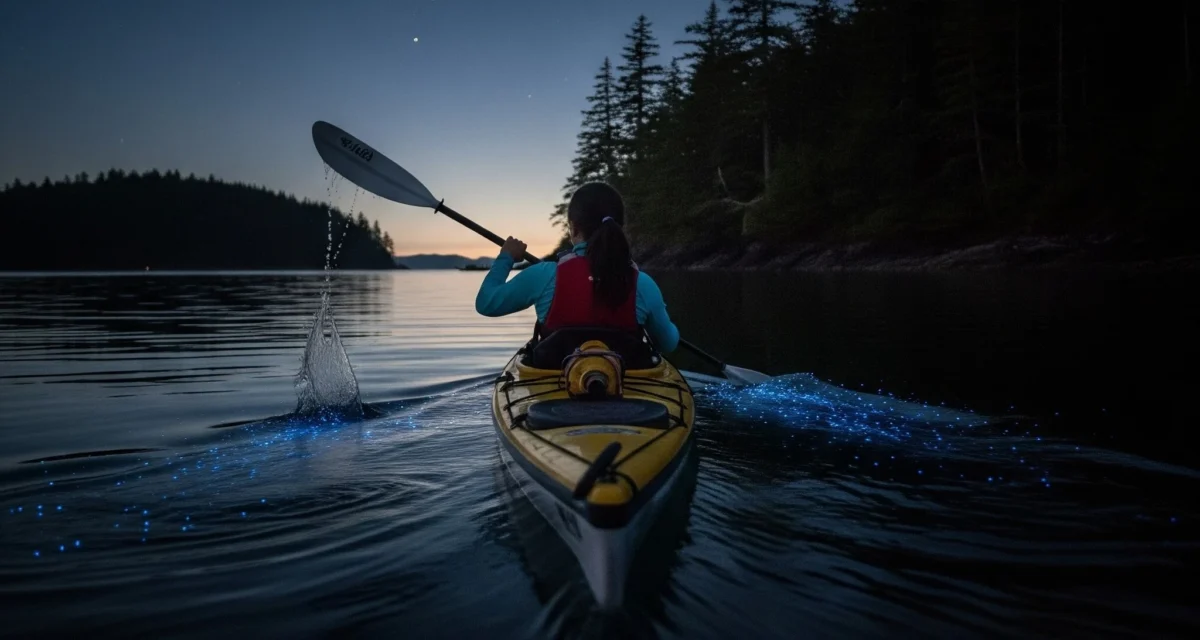
Sea Quest’s Bioluminescence Kayaking Tours in the Friday Harbor offer an unforgettable experience, running nightly at dusk. Led by our expert naturalist guides, you’ll paddle through the calm, protected waters as the sun sets and the stars emerge overhead. As darkness falls, the sea begins to sparkle with life—microscopic plankton light up with every stroke of your paddle, while glowing jellyfish, shimmering ctenophores, and flickering shrimp drift beneath your kayak like underwater fireflies. This rare natural phenomenon is only visible in a handful of places around the world—and the San Juan Islands are one of the best. Book your bioluminescence kayaking adventure today and witness one of nature’s most magical nighttime displays!
Night kayaking in the Friday Harbor is accessible to anyone with an adventurous spirit and is incredibly safe. No experience is necessary to join a guided night kayak tour with us. In fact, many of our guests in the San Juan Islands experience kayaking for the very first time at night with Sea Quest. Our expert night kayak guides manicure a safe, educational and entertaining tour. In no time you will be comfortably paddling in the safest waters with the highest densities of phytoplankton and the greatest chances of seeing vibrant bioluminescence! Don’t miss your chance to experience a night kayak adventure with Sea Quest Kayak Tours!
Bioluminescence and the lunar cycle have a strong relationship. A bright full moon will make the glowing organisms seem dimmer. Oppositely, a dark new moon will allow the full glory of bioluminescent organisms to shine! The “in-between” phases of the lunar cycle offer moderate displays. To increase your chances of seeing a good bioluminescence display on your kayak trip with Sea Quest, use the lunar calendar on this page and select a date with a darker moon. If you want to see a partial moon, the best time to do so is during the third quarter phase. This is when the moon is waning and rises later at night. The first quarter moon rises well before the sun sets, so it is not as visible. For more info, see our page on how to interpret a lunar calendar to maximize your chances kayaking in bioluminescence!

4 hours
All Group Sizes
All Ages
Beginner Friendly
$199
Daily at Dusk. April 1 - Nov 1.
Friday Harbor, WA
(437 Reviews)
Schedule: Bioluminescent Kayak Tour offered daily.
Meeting Place: Friday Harbor, San Juan Island. Look for our van and kayak trailer in the traffic circle adjacent to the Friday Harbor Ferry Terminal.
Meeting Time: Bioluminescence kayak trips usually begin at dusk. Note that the trip start times in our reservation system vary with seasonal daylight hours. Our online reservation system will indicate the exact meeting time if you enter a specific date. If the times don’t work for you, we may be able to change them to meet your needs so feel free to ask!
Itinerary: Our shuttle van takes you to the launch beach. The drive takes between 5 to 25 minutes. We provide a one hour kayak lesson on the beach. This lesson familiarizes everyone with the basic skills before we launch the sea kayaks in the dark. We then explore for about 1 – 1½ hours, covering 1 to 2 miles during the kayak adventure. We will paddle at a leisurely pace in search of good areas. If we find a rich spot we will float there to soak in the experience and look for the glowing outlines of fish and seals. Remember to bring a headlamp or flashlight but turn it off to enjoy the bioluminescence!
Finish Time & Place: Friday Harbor Ferry Terminal. 3 hours after we pick you up.
Total Time: Approximately 3 hours from meeting your guides to finish. Be aware that our weather, winds or currents can occasionally delay us!
Other creatures that contribute to this glowing spectacle include pulsating jellyfish, clusters of salps (gelatinous organisms), and even masses of mating marine worms. Each of these organisms uses bioluminescence for various purposes, such as communication, attracting prey, or deterring predators, making the sea at night a glowing and magical place.
The “Enemy of My Enemy is My Friend” hypothesis offers an intriguing explanation for bioluminescence in the sea. According to this theory, some organisms use their ability to glow as a defense mechanism against predators. When small predators, such as zooplankton, approach, the bioluminescent organisms release a burst of light. This glow may distract the predator or attract a larger predator that will target the zooplankton instead, diverting attention away from the glowing organism and giving it a chance to escape.
In addition to this defensive use, bioluminescence serves other purposes as well. Some creatures, like jellyfish, use their glow to attract prey, similar to how moths are drawn to a candle’s light. This strategy helps them lure in smaller organisms, such as phytoplankton, to feast upon. Meanwhile, creatures like nereid worms utilize their bioluminescence to attract mates, turning their glow into a sort of “sexy” beacon, signaling potential partners in the vast ocean depths. Overall, bioluminescence is a versatile tool that serves various functions in the underwater world, from self-defense and hunting to reproduction.
Book a kayak trip with Confidence: As a small family owned and operated company, all we ask is that give us the opportunity to show you the amazing wonders of kayaking in the San Juan Islands.
WE PROVIDE THE FOLLOWING:
Sea kayaks, all related sea kayaking trip gear, safety equipment, transportation to and from Friday Harbor and the launch beach, instruction and expert guides.
Suitable clothing and footwear for the beach, water bottle, HEADLAMP. Bring a warm sweater and rain jacket if windy or rainy. Click prepare for a San Juan Islands kayak tour for some tips.
Bioluminescence cannot be guaranteed. It can be suppressed by heavy winds or clouds that day. Views of the moon and stars may be obstructed by clouds, although these are rare June – August.
Our tours end well after dark. Make sure you book accommodations ahead of time for after your tour. The ferry system usually doesn’t run late enough to leave the island after your tour.

National Geographic chooses our San Juan Islands Kayaking tours in “10 Best Trips in the World for 2011.”

Sea Quest Kayak Tours is on ABC News! See us Kayaking with Orca Whales in the San Juan Islands.

San Juan Islands Kayaking Trips in Killer Whale Waters of Washington – a World’s Top 10 Adventure Bargain!

National Geographic chooses our San Juan Islands Kayaking tours in “10 Best Trips in the World for 2011.”